

How to Actually Read a Skincare Label When Your Skin Reacts to Everything
Date Published: 10/16/2026
Ever turned over a skincare bottle and wondered what any of those ingredients actually mean? After months of battling contact dermatitis, Patch founder Abby learned how to decode skincare labels, identify hidden allergens, and make better choices for reactive skin. Here’s what she wants you to know.

This post contains affiliate links. If you click and purchase, I may earn a small commission at no extra cost to you. Read my full disclosure here. Learn more
By Abby, Founder of Patch | Guest Contributor
The first time I really looked at the back of a skincare bottle, I didn't understand a single word. Everything was a wall of chemical names that could have meant anything. And for someone whose skin reacts to certain ingredients, that's exactly the problem.
One day, my skin started breaking out in these red, blotchy patches. My eyelids would sell, my cheeks would become puffy, and eventually my entire face would start peeling. For three months, I spent every night applying Aquaphor and hydrocortisone to desperately try to calm my skin.
When I I finally got a patch test, and found out I was allergic to the sunscreen I had been using for two years.
What I learned along the way is that reading a skincare label isn’t just about recognizing ingredients. It’s about understanding what those ingredients actually mean for your skin.
Here's what I found that actually helps.
The front of the bottle is advertising, while the back is the truth
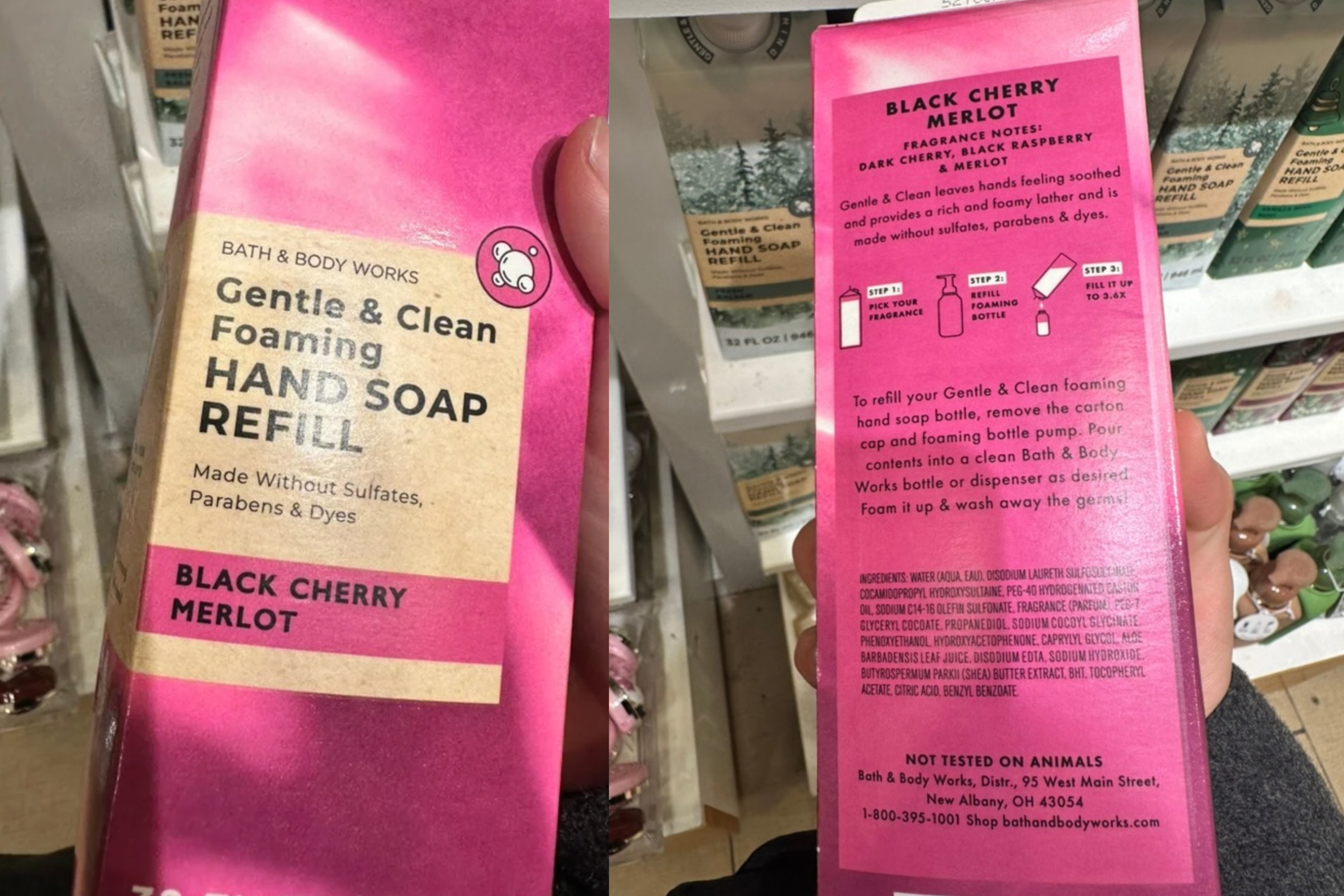
The front and back of a product can tell different stories
"Hypoallergenic." "Dermatologist-tested." "For sensitive skin." "Gentle."
None of these are regulated terms with a fixed meaning. In the United Statses, a company can put "hypoallergenic" on a product that contains one of the most common skin sensitizers there is, with little to no oversight. These words are written by the marketing team, not the medical one. That's why I learned to look past marketing claims and turn straight to the ingredient list. It's the most useful place to start when you're trying to understand what you're putting on your skin.
Ingredients Are Listed in Order of Concentration
This is one of the most useful things to understand about skincare labels.
In the United States, cosmetic ingredients are listed from the highest concentration to the lowest, all the way down to 1%. However, ingredients present with concentrations of 1% or less can be listed in any order after those present at higher concentrations.
That means ingredients near the top of the list generally make up a larger portion of the formula, while those near the bottom are typically present in small amounts. You wouldn't know the exact percentage, but you can get a better sense of how a product is formulated.
One thing to remember: Even a small amount of an ingredient can trigger a reaction if you're allergic to it. Just because something appears near the bottom of the list doesn't necessarily mean it's safe for your skin.
Learn Your Triggers and Their Aliases
Ingredients almost never go by their friendly names. Instead, they're listed by their INCI names, a standardized (often Latin or scientific) naming system used on cosmetic labels worldwide.
Vitamin E might show up as tocopherol. Oat might appear as Avena sativa. Shea butter might be called Butyrospermum Parkii Butter.
This matters because a single ingredient you react to can appear under several different names, and a product can look "free from" your trigger while containing it under an alias you didn't recognize.
If you have a known allergy, its worth keeping a list of the ingredient names and related substances a medical professional has advised you to avoid.
Watch the Catch-All Words
A few terms on a label aren't single ingredients. Instead, they're large categories hiding a whole group of things:
Fragrance / Parfum. This is one word that can legally stand in for dozens of undisclosed compounds, and fragrance is one of the most common causes of skin reactions. When you see "fragrance" or "parfum," you don't actually know what's in there.
"Unscented" is not "fragrance-free." Unscented products sometimes contain masking fragrance — added scent chemicals whose only job is to cover up the smell of the other ingredients. "Fragrance-free" is the term you actually want.
Essential oils. These get marketed as the "natural" alternative to synthetic fragrance, but reactive skin doesn't care whether a sensitizer came from a lab or a plant. Natural and gentle are not the same thing.
Be Suspicious of "free-from" Lists
A big "PARABEN-FREE · SULFATE-FREE · CRUELTY-FREE" badge tells you what a product doesn't have. It tells you nothing about what it does have — and companies sometimes swap out one flagged ingredient for a replacement that's just as likely to bother sensitive skin, then advertise the thing they removed. Read the actual list, not the badges.
Remember Cross-Reactivity
If your skin reacts to one ingredient, there's a decent chance it'll react to chemically related ones too, even when they have completely different names on the label. This is the most difficult part of reactive skin, because you can carefully avoid your known trigger and still break out from its cousin.
But First, Patch Test
Even after all of that, no label reading is a guarantee. Before you put a new product anywhere near your face, test a small amount on a discreet spot (the inner forearm works well) and wait 24 to 48 hours. It's slow and slightly annoying, and it will save you a genuinely miserable week more than once.
Where this got easier for me
I built Patch because memorizing aliases, cross-referencing sensitizers, catching the cross-reactive chemicals by hand is exhausting, and I was doing it standing in a store aisle trying to read the tiny label.
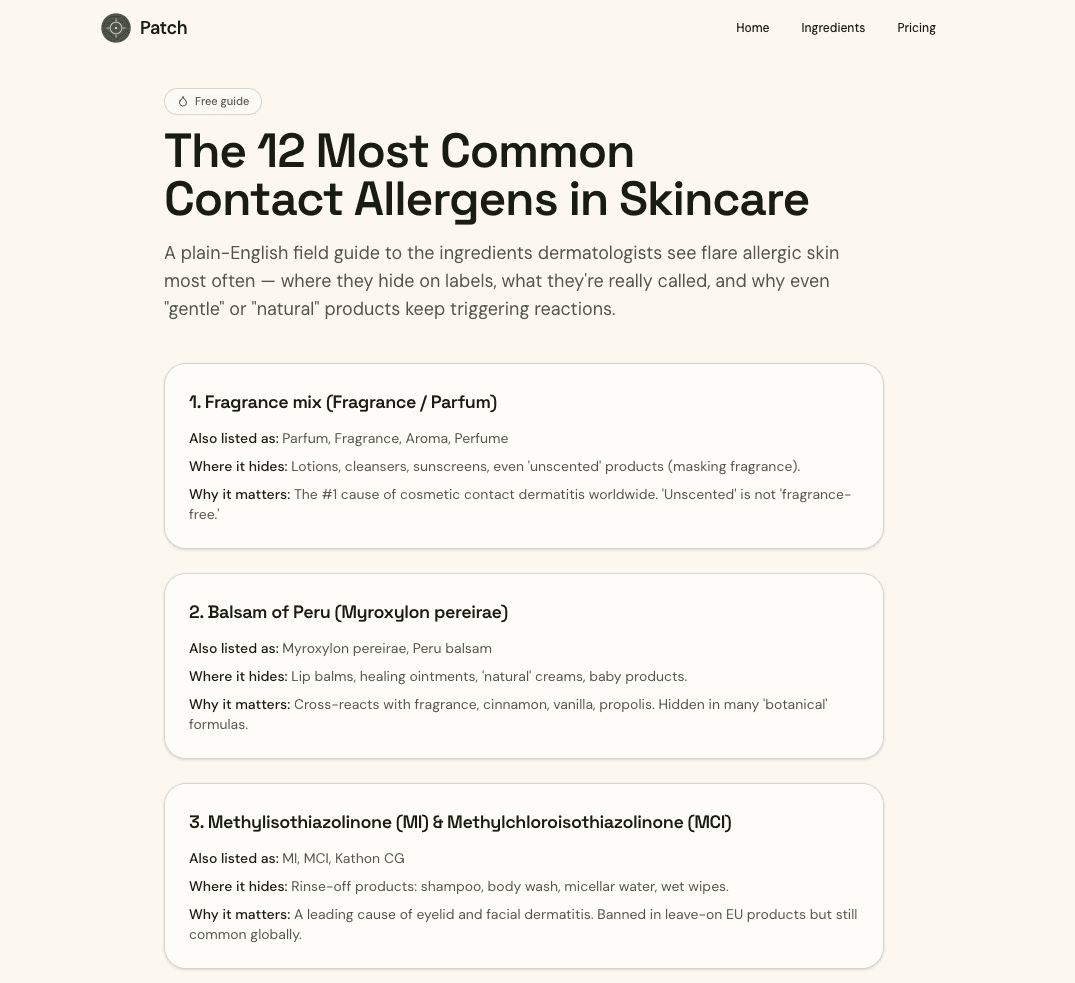
Patch lets you scan a product (by barcode or by pointing your camera at the ingredient list) and checks it against your own known triggers plus a database of common sensitizers. It sorts every ingredient into four buckets — Avoid, Seen Before, Common Sensitizer, and Not Flagged — so instead of decoding the whole label yourself, you can see at a glance whether something is worth trying. It's not magic, and it doesn't replace a patch test or a dermatologist. It just does the tedious cross-referencing part so you don't have to hold all of it in your head.
But whether or not you ever use a tool like mine, the core habit is the same: turn the bottle around, ignore the promises on the front, and read the list. Your skin is reacting to what's actually in the product — not to what the label claims it is. Abby is the founder of Patch, an app that helps people with reactive skin track ingredients and spot allergens.
Abby is the founder of Patch, a comprehensive skincare database app that helps people with reactive skin track ingredients and identify potential allergens. Inspired by her own experience with contact dermatitis, she created Patch to make navigating skincare ingredients more accessible.
Tags: skincare, allergies, ingredients, dermatitis,
Canonical: https://www.thegoodstandard.org/blog/how-to-read-skincare-ingredient-labels